
Corrugated tube
The white ribbed tube that carries pellets up to the Hopper. The Vacuum pump draws pellets through it from whatever container holds the material — a plain pellet bucket, or the D1 dryer standing next to the printer.
Function
Section titled “Function”- Transports pellets from the material source to the hopper via vacuum suction
- Flexible enough to route around the machine
- Ribbed design allows bending without collapsing the bore
The rule that matters: no gravity drop
Section titled “The rule that matters: no gravity drop”This single rule replaces any fixed maximum length. What matters is the shape of the run, not how many metres it is:
| Requirement | Why |
|---|---|
| No descending sections | Pellets fall into them and pile up until the line is plugged |
| No dips or U-bends | Same failure, at the bottom of the dip |
| Always rising toward the hopper | Material only moves when the vacuum moves it, never on its own |
| Airtight seal at the hopper | Even a small leak breaks the suction |
How the feeding line is arranged
Section titled “How the feeding line is arranged”The feed line is three sections, not one tube. Getting this wrong is the most common source of confusion, because each section is a different type:
| # | Section | Type | Role |
|---|---|---|---|
| 1 | From the dryer | White corrugated | Leaves the pellet gate under the D1 dryer tank, clamped on with a worm-drive hose clamp |
| 2 | The long run | Smooth rigid grey pipe | The static middle section. Being rigid it holds the bore open and stops the line sagging into a belly |
| 3 | To the extruder | White corrugated | The moving section — flexes to follow the gantry and the extruder |
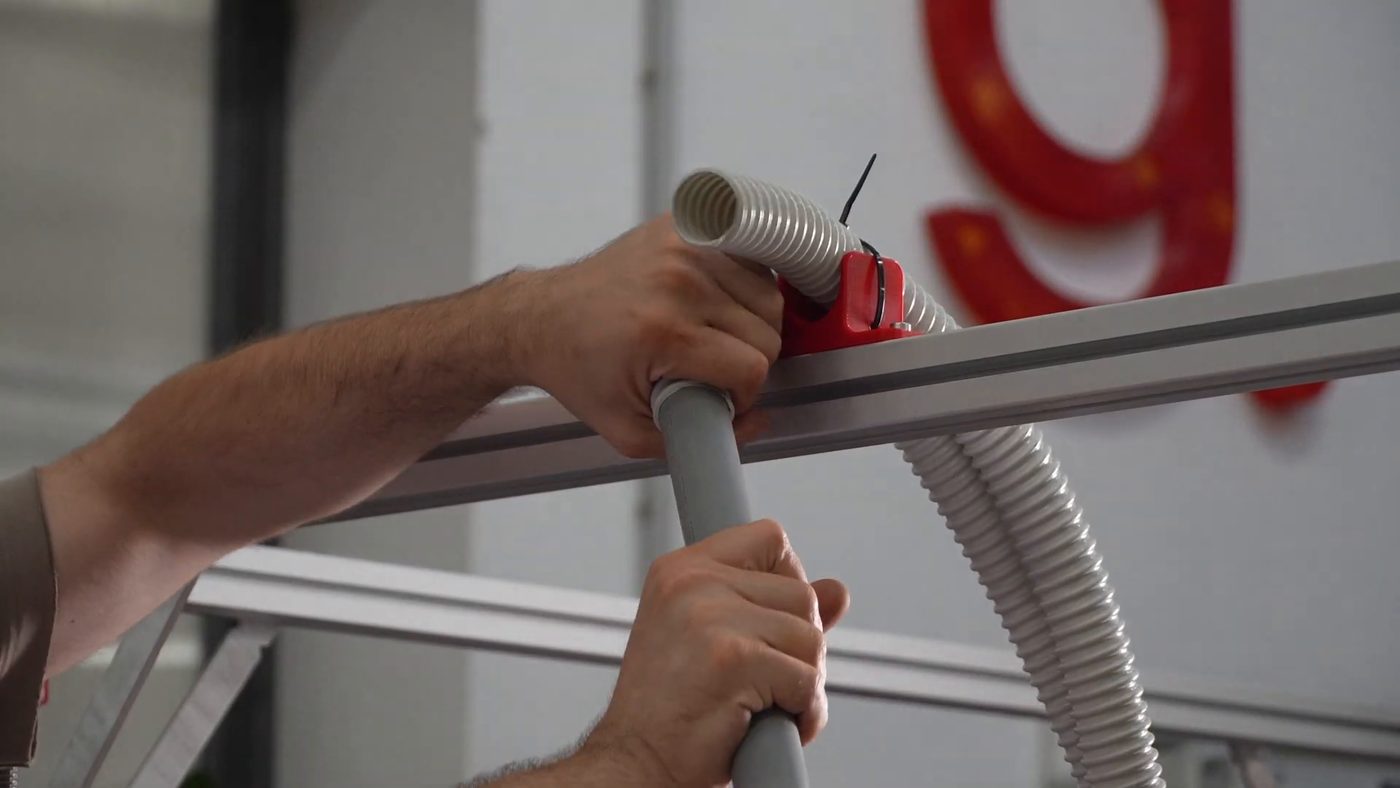
From How the G1 Automatic Feeding System works — 2:15
Both corrugated sections and the rigid pipe are part of the same line — a machine is not “using the wrong tube” because it has both.
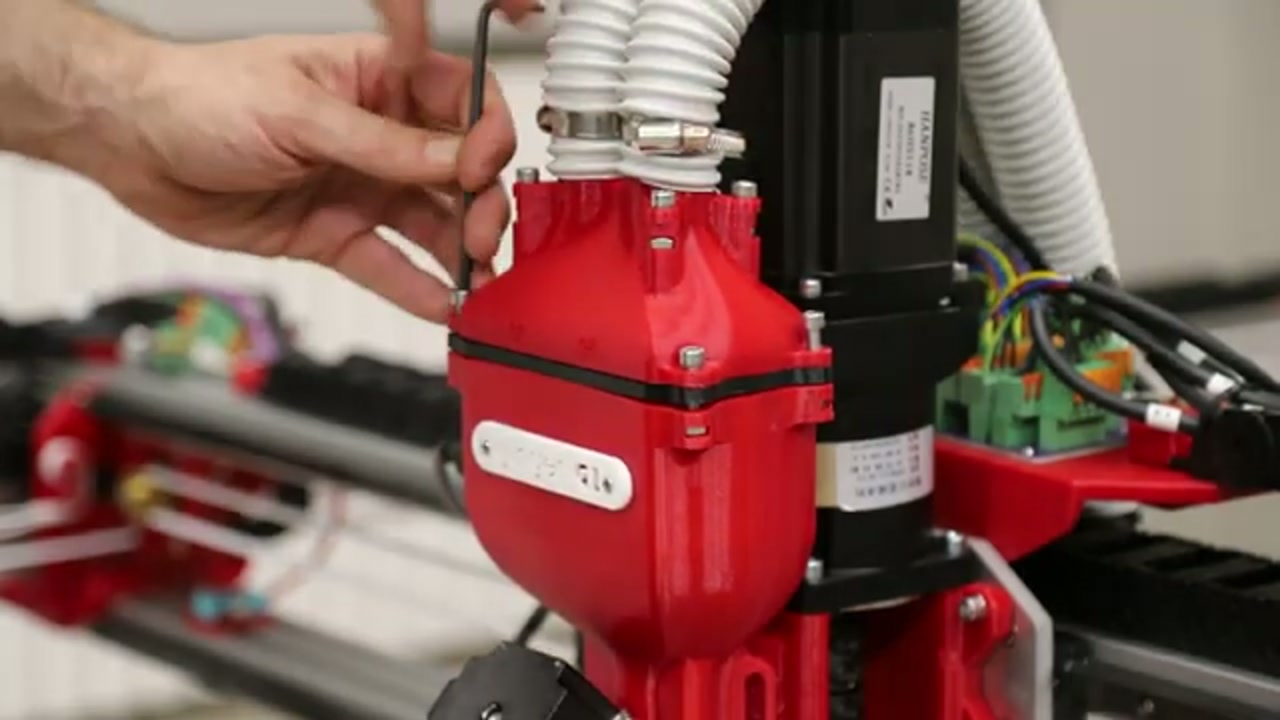
Securing the moving section
Section titled “Securing the moving section”The corrugated section that follows the extruder is secured with a zip tie at the frame end (assembly video, 13:48) so its slack cannot snag the gantry. If you re-route it, put the tie back.
The most common failure point
Section titled “The most common failure point”The joint between the corrugated tube and the hopper is the #1 cause of suction failure across all customer cases. Air leaks here mean the vacuum cannot build enough differential pressure to lift pellets.
What to check when suction is weak:
- Check that the clamp is tight
- Check that the gasket (rubber seal inside the fitting) is intact and seated correctly
- Compress the gasket slightly by hand — it should feel firm and springy, not flat or cracked
- Replace the gasket if it shows any compression set (permanently flattened)
See Hopper suction problems for the full diagnostic flow.
Routing guidelines
Section titled “Routing guidelines”- Run straight and rising from the material source to the hopper, with no descending section anywhere
- No dips — a low section acts as a trap for flat or small pellets
- Keep the run short — not because of a length limit, but because a short run is easier to keep rising
- Place the material source close to the machine
Why the shape matters more than the length
Section titled “Why the shape matters more than the length”Pellets are lifted by air velocity, not suction force alone:
- Air can flow past flat or fines-heavy pellets without picking them up
- Recycled and irregular pellets are especially affected
- Anywhere the line stops rising, material settles instead of travelling — and once a plug forms, airflow drops and the plug grows
Pellet types
Section titled “Pellet types”The feeding line handles ordinary pellet shapes without trouble — uniform, flat, small or irregular, they all travel fine as long as the line is routed correctly.
There is one real exception:
Replacement
Section titled “Replacement”If the tube is kinked, cracked, or permanently deformed, replace it. The tube is standard corrugated pneumatic hose (verify the inner diameter matches the fittings). Available from Ginger support or industrial hose suppliers.
Related notes
Section titled “Related notes”- Hopper suction problems — main troubleshooting guide for the feeding system
- Hopper — the container the tube connects to
- Vacuum pump — the suction source
- SmoothFlow — lubricant that helps transport difficult pellets